Every business with a limited marketing budget eventually asks the same question: should we invest in SEO or put that money into social media? It’s a fair question, and it doesn’t have a one-size-fits-all answer, no matter how confidently some marketing blogs claim otherwise.
Both channels can grow a business. Both can also waste months of effort if you approach them without a clear picture of what each one actually does well. This SEO vs social media marketing comparison breaks down how the two channels really differ, where each one shines, and how to decide which deserves your attention first — or whether you need both running at the same time.
What SEO Actually Is
Search engine optimization is the practice of structuring your website and content so it ranks higher in search results for terms your customers are already typing into Google. When someone searches “best project management software” or “plumber near me,” SEO determines whether your business shows up on page one or gets buried on page seven, where almost nobody ever scrolls.
SEO works on three main levels: technical health (how easily search engines can crawl and understand your site), content (whether your pages actually answer what people are searching for), and authority (how many other credible sites link back to yours). Get all three right, and your website starts pulling in visitors who are actively looking for what you sell — without you paying for each click.
What makes SEO unusual compared to almost every other marketing channel is that it improves with age instead of losing value. A blog post published two years ago can still be your top traffic driver today if it was built around the right keyword and kept reasonably up to date. That’s a stark contrast to a paid ad, which stops working the moment you stop paying for it, or a social post, which is effectively invisible within a day or two of publishing.
The tradeoff is patience. Search engines need time to trust a new page, especially on a newer website with limited authority. Businesses that expect first-page rankings within a month are usually disappointed, not because SEO doesn’t work, but because they misunderstood the timeline going in.
What Social Media Marketing Actually Is
Social media marketing is the practice of building an audience and driving engagement on platforms like Instagram, TikTok, LinkedIn, and Facebook, then using that audience to generate awareness, traffic, and sales. Unlike SEO, social media doesn’t wait for someone to search for you. It puts your business directly in front of people while they’re scrolling, whether or not they were thinking about your product at that moment.
This makes social media a discovery channel rather than an intent-based one. People aren’t typing “I need this” into their feed — they’re being introduced to a problem or product they didn’t know they needed yet. If you want a deeper breakdown of what actually works on social platforms right now, this guide to social media marketing tips that actually work in 2026 covers platform selection, content formats, and consistency in more detail.
Social media also rewards a completely different skill set than SEO does. Where SEO leans on research and structured writing, social media rewards timing, personality, and the ability to hook someone’s attention in the first two seconds of a video or the first line of a caption. A brand with a strong, distinct voice can build a loyal following relatively quickly, even without a large budget, simply because platforms are designed to surface content that keeps people engaged, regardless of who’s posting it.
What the Numbers Actually Show
Understanding SEO vs social media marketing starts with grounding the comparison in real behavior rather than assumptions. Businesses that invest consistently in SEO often report that organic search becomes one of their largest traffic sources within twelve to eighteen months, frequently outpacing paid channels in volume once rankings mature. Social platforms, meanwhile, continue to show strong short-term engagement, but reach for any single post typically drops off within 48 hours as the algorithm moves on to newer content.
Industry benchmarks from sources like HubSpot consistently show that inbound leads generated through organic search tend to have higher close rates than leads generated through social media, largely because search traffic arrives with existing intent. That doesn’t make social media less valuable — it just means, in the SEO vs social media marketing debate, that the two channels are optimized for different stages of the customer journey, and measuring them against the same metrics tends to produce a misleading comparison.
SEO vs Social Media Marketing: The Core Differences
Before deciding which one deserves your budget, it helps to understand exactly how SEO vs social media marketing behave differently in practice.
Speed to Results
Social media marketing wins here, hands down. Post a strong piece of content today, and you can see likes, comments, shares, and even sales within hours. SEO doesn’t work that way. A new page typically takes weeks to get indexed and months to climb toward the top of search results, especially in competitive niches. If you need visibility this week, social media is the faster lever to pull.
Cost Over Time
SEO is the long game that gets cheaper the longer you stick with it. Once a page ranks well, it can keep bringing in visitors for years without additional spend — you’re not paying per click or per impression. Social media marketing, on the other hand, requires constant content production to stay visible. Stop posting, and your reach drops off almost immediately, because algorithms reward active accounts and quietly bury inactive ones.
Longevity of Results
A well-optimized blog post can rank on Google for three, four, even five years with only occasional updates. A social media post, by contrast, has a shelf life measured in hours or days before it disappears into the feed’s history, rarely to be seen again unless someone specifically searches your profile. This is the single biggest structural difference between the two channels: SEO builds an asset, social media builds momentum.
Type of Traffic You Get
SEO traffic tends to come from people with clear intent — they searched for a solution, which means they’re often closer to a buying decision. Social media traffic tends to be earlier in the customer journey; people are browsing, not necessarily shopping, so conversion rates on that first interaction are typically lower, even if reach and brand awareness are higher.
Control Over the Platform
With SEO, you own your website. Search algorithms change, but you’re not locked out of your own asset the way you can be on a social platform. Social media marketing depends entirely on a third-party algorithm and platform rules that can shift overnight, affecting your reach without warning. This is a real risk businesses underestimate until it happens to them.
The Case for SEO Over Social Media Marketing
SEO makes the most sense for businesses selling products or services people actively search for — home services, B2B software, professional services, e-commerce, and anything with clear “buying intent” keywords. When weighing SEO vs social media marketing for this kind of business, search almost always wins because the customer has already decided they have a problem. If your ideal customer types a question into Google before making a decision, ranking for that question puts you directly in front of them at the exact moment they’re ready to act.
It’s also the better long-term investment for businesses that want to build a durable, owned traffic source rather than one that depends on a platform’s mood. A business with strong SEO can weather algorithm changes on social media because search traffic isn’t tied to any single platform’s engagement rules. Tools like Google Search Console let you track exactly which queries are driving traffic to your site, giving you a clear, ongoing view of what’s working.
The Case for Social Media Marketing Over SEO
Social media marketing makes more sense for businesses that sell visually appealing products, target younger demographics, or need to build brand awareness before customers even know they have a problem worth solving. Fashion, food, fitness, beauty, and lifestyle brands tend to thrive here because the product sells itself through imagery and video in a way a search result never could.
It’s also the better choice when speed matters more than durability — launching a new product, testing messaging, or building buzz around an event all favor social media’s immediate feedback loop. And because platforms like TikTok and Instagram reward creativity over budget, a small business with a strong creative sense can outperform a much bigger competitor with a larger ad spend.
When SEO Wins in the SEO vs Social Media Marketing Debate
SEO tends to outperform social media when your customers actively search before buying, when you’re competing in a niche with clear, well-defined keywords, and when your business model rewards long-term compounding traffic over quick spikes. A dentist, an accounting firm, or a SaaS company selling to other businesses will almost always get more sustainable value from ranking on Google than from chasing viral moments on social media.
When Social Media Marketing Wins Over SEO
Social media tends to outperform SEO when your product benefits from visual storytelling, when your audience skews younger and spends significant time on these platforms, or when you need visibility fast — a product launch, a seasonal promotion, or building an audience from zero. It’s also the stronger choice for businesses built around personal brand and community, where trust is built through consistent presence rather than search rankings.
Why the Best Businesses Don’t Choose Just One
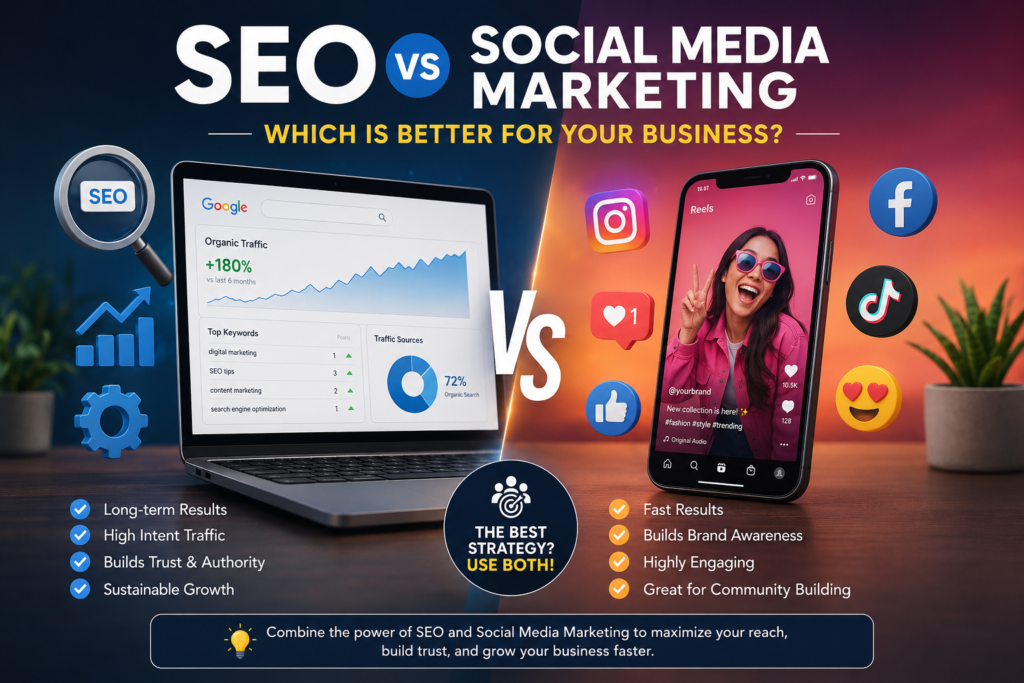
In practice, framing this as SEO versus social media marketing is a bit of a false choice. The businesses that grow fastest typically use both, just with different roles, rather than treating SEO vs social media marketing as an either-or decision. Social media builds awareness and drives immediate engagement; SEO captures the people who later go searching for your brand or your solution by name. One feeds the other.
A piece of content can work both angles at once: publish a detailed article optimized for search, then break it into short clips and posts to promote on social media. This is exactly the kind of repeatable system a solid digital marketing plan is built around — choosing channels that reinforce each other instead of competing for the same limited time and budget.
How to Decide Which to Prioritize: SEO vs Social Media Marketing
If you’re working with limited resources and can’t run both channels well at once, a few questions can help you decide where to start.
Ask yourself: Do my customers search for what I sell, or do they discover it by accident? If they search, start with SEO. Do I need results in the next few weeks, or can I invest for the next six to twelve months? If you need speed, start with social media. Is my product something people can understand from a single image or short video, or does it require explanation? Visual products lean social; complex products lean search.
Also consider your own strengths. A founder who’s comfortable on camera and enjoys creating content will naturally do better with social media in the early stages. A founder who prefers writing and research may find SEO a more sustainable long-term fit.
A Simple Framework for Combining SEO and Social Media Marketing
For businesses ready to run both channels, a workable starting split looks like this: dedicate 60% of your content effort to SEO-focused, long-form content that targets specific search queries, and 40% to repurposing that content into short-form posts, reels, and updates for social media. This keeps your content engine efficient — you’re not creating two entirely separate content calendars, just adapting the same core ideas for two different audiences and formats.
If your business model includes referral or partnership-based income, this same content also supports other channels. A blog post that ranks well and drives consistent traffic, for example, is exactly the kind of asset that works well alongside an affiliate marketing strategy, since organic search traffic tends to convert better on recommendation-based content than cold social traffic does.
Common Mistakes to Avoid With SEO vs Social Media Marketing
A few patterns show up repeatedly in businesses that struggle to get results from either channel.
Expecting SEO to work overnight. Search rankings take months, not weeks. Businesses that give up after six weeks were never going to see results in that window regardless of strategy quality.
Treating social media as a broadcast channel. Posting without ever replying to comments or engaging with followers signals to the algorithm — and to real people — that the account isn’t actually active in the community sense that platforms reward.
Ignoring analytics on both sides. Without tracking which keywords bring in SEO traffic or which posts actually drive social engagement, you’re optimizing blind and repeating whatever worked by luck rather than by design.
Splitting attention too thin too early. Trying to run five social platforms and a full SEO content calendar with one person on the team usually means nothing gets done well. Better to master one channel before adding the next.
Assuming one channel replaces the other. SEO doesn’t build brand awareness the way social media does, and social media doesn’t capture high-intent search traffic the way SEO does. They solve different problems, not the same problem twice.
Frequently Asked Questions About SEO vs Social Media Marketing
Is SEO or social media marketing cheaper?
SEO typically costs more upfront in time and content investment but becomes cheaper per visitor over time, since you’re not paying to maintain rankings once they’re established. Social media marketing has a lower barrier to entry but requires ongoing content production to sustain reach, which adds up in time or hired help over the long run.
Can a small business really compete with SEO against bigger competitors?
Yes, especially by targeting specific, less competitive keywords instead of broad terms dominated by large brands. A local business or niche service provider often has an easier time ranking for detailed, specific searches than a national competitor does.
Which channel is better for e-commerce?
Most e-commerce brands benefit from running both, but social media often drives the initial product discovery, while SEO captures people searching for reviews, comparisons, or the product by name later in their decision process.
How long before social media marketing shows real results?
Engagement can appear within days, but building an audience large enough to meaningfully affect sales usually takes three to six months of consistent posting and community engagement.
Should a brand-new business start with SEO or social media?
A brand-new business with no existing audience often benefits from starting with social media to build initial visibility and traffic, then layering in SEO once there’s a website with enough content and authority to start climbing search rankings.
Final Verdict on SEO vs Social Media Marketing: Which Is Better?
Neither channel is objectively better — the right answer depends entirely on what your business sells, who buys it, and how much time you have before you need results. If your customers search for solutions before buying and you’re playing a long-term game, SEO deserves the bigger share of your effort. If your product benefits from visual appeal and you need to build awareness quickly, social media marketing should come first.
For most businesses, though, the real answer to the SEO vs social media marketing question isn’t either one on its own — it’s SEO and social media marketing, working together as part of one plan. Start with whichever channel matches your customers’ behavior and your own timeline, build it into a repeatable system, and add the second channel once the first one is generating consistent, measurable results.