
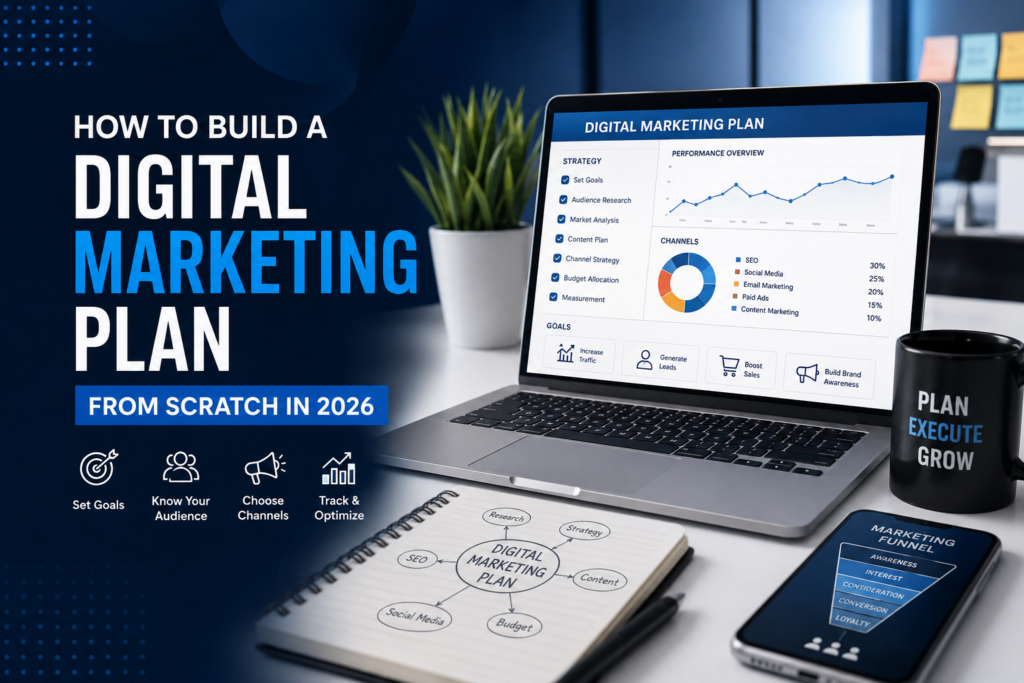
Most businesses don’t fail at digital marketing because they lack ideas. They fail because they never turn those ideas into an actual plan.
They post on Instagram when they remember to, run a Google ad when a competitor does, and send an email blast once a quarter — then wonder why nothing compounds. A real digital marketing plan fixes that. It turns scattered activity into a system with a direction, a budget, and a way to know whether it’s working.
If you’re starting from zero this year, the good news is that you don’t need a 40-page strategy document or a six-figure budget. You need a clear process. Below is exactly how to build a digital marketing plan, step by step, using the same framework agencies charge thousands of dollars to deliver.
This matters more in 2026 than it did a few years ago. Ad costs on major platforms keep climbing, organic reach on social media keeps shrinking, and search results now mix AI-generated answers with traditional links, which changes how people find businesses in the first place.
Winging it worked when competition was lower and attention was cheaper. It doesn’t work as well now, which is exactly why a written plan — one that forces you to prioritize instead of chase every new tactic — pays off more than ever.
What a Digital Marketing Plan Actually Is
A digital marketing plan is a written roadmap that connects your business goals to the specific online channels, content, and budget you’ll use to reach them. It answers four questions in order: What are we trying to achieve? Who are we trying to reach? Where do we reach them? And how will we know it’s working?
Notice what’s missing from that list: tactics. Most people start with tactics — “we should post more on TikTok” or “let’s try Google Ads” — before they’ve answered the first three questions. That’s backwards, and it’s the single biggest reason marketing budgets get wasted.
If you want a broader primer on what digital marketing covers before diving into planning, this beginner’s guide to digital marketing is a solid starting point.
Step 1: Audit Where You Stand Today
Before you plan where you’re going, you need an honest picture of where you are. This isn’t optional, and it’s the step most beginners skip because it feels like busywork. It isn’t.
Pull together:
- Your website traffic and top-performing pages (Google Analytics or your CMS dashboard will show this)
- Your current social media following and engagement rates across platforms
- Your email list size and average open/click rates
- A list of every marketing channel you’re currently using, even informally
- A quick competitor scan — what are three competitors doing that you aren’t?
This audit gives you a baseline. Without it, you have no way to measure progress six months from now, and you’ll end up guessing whether your digital marketing plan is actually working.
Step 2: Set Goals You Can Actually Measure
“Grow our business” is not a goal. It’s a wish. A real marketing goal has a number and a deadline attached to it.
Instead of “increase brand awareness,” write “grow Instagram followers from 2,000 to 5,000 by December.” Instead of “get more customers,” write “generate 150 qualified leads per month through the website contact form by Q3.”
This matters more than it sounds like it should, because vague goals lead to vague strategies, and vague strategies produce vague results that are impossible to evaluate.
Marketers call this the SMART framework — Specific, Measurable, Achievable, Relevant, Time-bound — and it’s worth actually using rather than skimming past. Every goal in your digital marketing plan should survive that filter before it goes on the page.
Common goal categories worth considering:
- Traffic goals (organic visitors, referral traffic, direct visits)
- Lead generation goals (form fills, demo requests, email signups)
- Revenue goals (online sales, average order value, conversion rate)
- Engagement goals (social followers, email open rates, time on site)
- Brand goals (search volume for your brand name, share of voice)
Pick two or three. Trying to move ten metrics at once with a limited budget is how digital marketing plans collapse under their own weight.
Step 3: Get Specific About Who You’re Talking To
Every channel decision, every piece of content, and every ad you’ll ever run as part of your digital marketing plan depends on this step. If you don’t know who you’re talking to, you can’t know where to find them or what to say.
Build a simple customer profile that covers:
- Age range and general demographics
- The specific problem your product or service solves for them
- Where they spend time online (platforms, forums, search behavior)
- What convinces them to buy — price, trust, convenience, status, urgency
- What stops them from buying — cost, uncertainty, lack of awareness
You don’t need market research firms for this. Look at your existing customers, check your website analytics for demographic data, read the comments and DMs you already get, and talk to five actual customers if you can. Real answers beat assumptions every time.
Step 4: Pick Your Channels (Don’t Try to Do Everything)
This is where most first-time digital marketing plans go wrong. The instinct is to be everywhere — a business account on every platform, a blog, a podcast, paid ads, an affiliate program — all launched in the same month.
That approach spreads a limited budget and even more limited time so thin that nothing gets done well.
Instead, choose two or three primary channels based on where your audience actually is and what your goals require. Here’s a quick breakdown of the main options.
Search and SEO
Search engine optimization is the slow-build channel: it takes months to gain traction, but the traffic it produces is free and compounds over time. If your customers actively search for solutions to their problem — “best accounting software for freelancers,” for example — SEO deserves a place in your digital marketing plan. Tools like Google Search Console are essential here, since they show you exactly which search queries are already bringing people to your site.
Content Marketing
Blog posts, videos, case studies, and guides that answer real questions your audience is asking. Content marketing feeds your SEO efforts, gives you something to share on social media, and builds the kind of trust that eventually turns into sales. It’s slow but durable — a good article can bring in traffic for years.
Social Media
Social platforms are where relationship-building and brand visibility happen, and increasingly where product discovery happens too. The mistake is trying to run every platform at once instead of going deep on one or two where your audience actually spends time. If you’re building this piece of your plan, this breakdown of social media marketing strategies for business growth walks through platform selection, content types, and posting consistency in more depth.
Still one of the highest-return channels available, largely because you own the list — no algorithm can bury your message the way it can on social media. A simple welcome sequence and a monthly newsletter will outperform most businesses’ entire social media effort in terms of direct revenue per hour invested.
Paid Advertising
Google Ads, Meta Ads, and LinkedIn Ads let you buy visibility instead of earning it slowly. Paid is the fastest way to test whether an offer or message resonates, because you get data in days instead of months. It’s also the easiest way to lose money quickly if you launch a campaign without a clear audience and a tested landing page first. Platforms like Google Ads provide detailed targeting and reporting, but they reward businesses that already know their numbers — cost per lead, average customer value — going in.
Affiliate Marketing
If your product or service lends itself to referral-based promotion, an affiliate program can turn other people’s audiences into a sales channel without upfront advertising spend. This works especially well for digital products, software, and online courses. If this channel fits your business model, this guide to affiliate marketing for beginners covers how to structure a program and choose partners worth working with.
Whichever channels you pick, write down why each one made the cut. If you can’t connect a channel back to one of your Step 2 goals, cut it from the digital marketing plan.
Step 5: Build Your Content Engine
Once channels are chosen, your digital marketing plan needs a repeatable process for producing content, not a one-off burst of posts before everyone loses momentum. A working content engine has three parts:
Pillars — three to five broad topics your business is credible talking about. These come directly from the problems your audience has (Step 3).
Formats — decide which formats you’ll actually produce consistently: blog posts, short videos, carousels, email newsletters, case studies. Fewer formats done well beats five formats done sporadically.
Repurposing — one well-researched blog post can become a newsletter section, three social posts, and a short video script. This is how small teams produce a consistent volume of content without burning out.
Step 6: Set a Budget That Matches Your Goals
Every digital marketing plan needs a real number attached to it. Your budget should be split across three categories: paid media (ad spend), tools and software (analytics platforms, email tools, design software), and content production (writing, design, video). A common starting split for small businesses is roughly 50% paid media, 30% content production, and 20% tools — though this shifts heavily depending on which channels you chose in Step 4. A plan built entirely around organic content and SEO will spend almost nothing on paid media early on and more on content creation instead.
Whatever the split, write the numbers down. A budget that exists only in your head isn’t a budget — it’s a guess you’ll exceed by March.
Step 7: Put Everything on a Calendar
A digital marketing plan without a calendar is a wish list. Break your quarterly goals into monthly themes, then into weekly content and campaign tasks. This doesn’t need to be complicated — a shared spreadsheet or a free tool like Trello works fine for most small teams.
The calendar should include content publish dates, campaign launch and end dates, key promotional periods relevant to your industry, and review checkpoints where you actually look at the data and adjust.
Step 8: Track the Right Numbers
Go back to the goals you set in Step 2 and track only the metrics tied to them. Vanity metrics — follower counts, likes, impressions — feel good but rarely tell you whether the business is actually growing. Revenue-connected metrics do.
At minimum, track:
- Website traffic by source (organic, social, paid, referral)
- Conversion rate at each stage of your funnel
- Cost per lead and cost per acquisition for any paid channels
- Email open, click, and conversion rates
- Return on ad spend (ROAS) for paid campaigns
Set a monthly review where you actually look at this data against your goals — not just collect it. A digital marketing plan that’s never reviewed isn’t a plan, it’s a document that gets ignored after the first two weeks.
Common Mistakes That Derail a Digital Marketing Plan
A few patterns show up again and again in plans that fail to deliver results:
Launching everything at once. Five new channels in month one means none of them get the attention needed to actually work.
Copying competitors instead of solving your own audience’s problem. What works for a competitor with a different customer base, budget, and brand history won’t automatically work for you.
No clear owner for each task. Plans built by committee with no single person accountable for execution tend to stall out by week three.
Ignoring the data until the quarterly review. Waiting three months to check whether a campaign is working means three months of wasted spend if it isn’t.
Treating the plan as final. The best digital marketing plans get revised monthly based on what the data actually shows, not what looked good on paper in January.
A Simple 90-Day Framework You Can Copy
If the full digital marketing plan above feels like a lot to build from scratch, here’s a compressed version to get moving in the next three months.
Days 1–15: Complete your audit, set two or three SMART goals, and define your target customer profile.
Days 16–30: Choose your two primary channels, set up tracking (Google Analytics, a CRM, or whatever fits your business), and build your content calendar for the next 60 days.
Days 31–75: Execute consistently. Publish on schedule, run any planned ad tests, and send your email sequence. Resist the urge to change strategy every week — give tactics time to show results.
Days 76–90: Review everything against your original goals. Keep what worked, cut what didn’t, and build your next 90-day digital marketing plan based on actual performance instead of assumptions.
Where Digital Marketing Is Heading in 2026
A few shifts are worth building into your digital marketing plan rather than reacting to later. AI-assisted content creation and personalization are now table stakes rather than a competitive edge — the businesses pulling ahead are the ones using AI to move faster while still keeping a human editorial eye on quality.
Short-form video continues to dominate attention across nearly every platform, including ones that weren’t originally built around it. Search behavior is also shifting, with more discovery happening through AI-powered answer engines alongside traditional search, which means content built to genuinely answer questions performs better than content built purely to rank.
Finally, privacy-focused advertising continues to push marketers toward first-party data — your email list and your own analytics — rather than relying entirely on third-party ad platforms.
None of this means starting over. It means building flexibility into your digital marketing plan so you can adjust channel mix and content formats as these trends solidify, rather than treating your 2026 plan as fixed for the next twelve months.
Tools Worth Setting Up Before You Launch
You don’t need an expensive tech stack to run a solid digital marketing plan, but a handful of tools make execution and tracking dramatically easier. Google Analytics is non-negotiable — it’s free, and it’s the only reliable way to see where your traffic actually comes from and what people do once they land on your site. Pair it with Google Search Console to understand which queries bring people in organically.
For content and design, Canva covers most small-team needs without requiring a designer on staff. For email, platforms like Mailchimp or ConvertKit handle list management, automation, and basic reporting without a steep learning curve. And for social scheduling, a tool like Buffer or Hootsuite means you can batch a week or a month of posts in one sitting instead of logging in daily.
The point isn’t to collect software. It’s to remove friction from the parts of your digital marketing plan that need to happen consistently — tracking, publishing, and reporting — so they actually get done.
Frequently Asked Questions
How long should a digital marketing plan cover?
Most small businesses do best with a rolling 90-day plan nested inside a broader annual direction. Ninety days is short enough to stay realistic and long enough to see whether a channel is actually working.
Do I need a big budget to get started?
No. Organic channels like SEO, content, and email cost time rather than money. A meaningful paid campaign can start with a few hundred dollars a month — the goal early on is learning what converts, not scaling spend.
Which channel should a total beginner start with?
If you’re unsure, start with one owned channel (your website and email list) and one discovery channel (the social platform your specific audience actually uses). That combination lets you build an audience you control while also getting in front of new people.
How often should I revisit the digital marketing plan?
Review performance monthly and do a deeper strategy revision every quarter. Anything less frequent means you’re flying on outdated assumptions; anything more frequent and you risk reacting to noise instead of real trends.
What’s the biggest reason digital marketing plans fail in practice?
Inconsistency. A mediocre digital marketing plan executed consistently for six months will almost always outperform a brilliant plan that gets abandoned after three weeks.
Final Thoughts
A digital marketing plan doesn’t need to be complicated to work — it needs to be specific, written down, and reviewed regularly. Start with an honest audit of where you stand, set goals with real numbers attached, get precise about who you’re trying to reach, and choose a small number of channels you can actually execute well. Everything else — the content, the ads, the emails — is just the tactics that fill in a plan you’ve already built.
The businesses that win in 2026 won’t be the ones doing the most. They’ll be the ones doing the right few things consistently, measuring what matters, and adjusting based on real data instead of guesswork. Write the plan down, put it on a calendar, and revisit it before the quarter is over — that alone puts you ahead of most competitors still marketing on instinct.