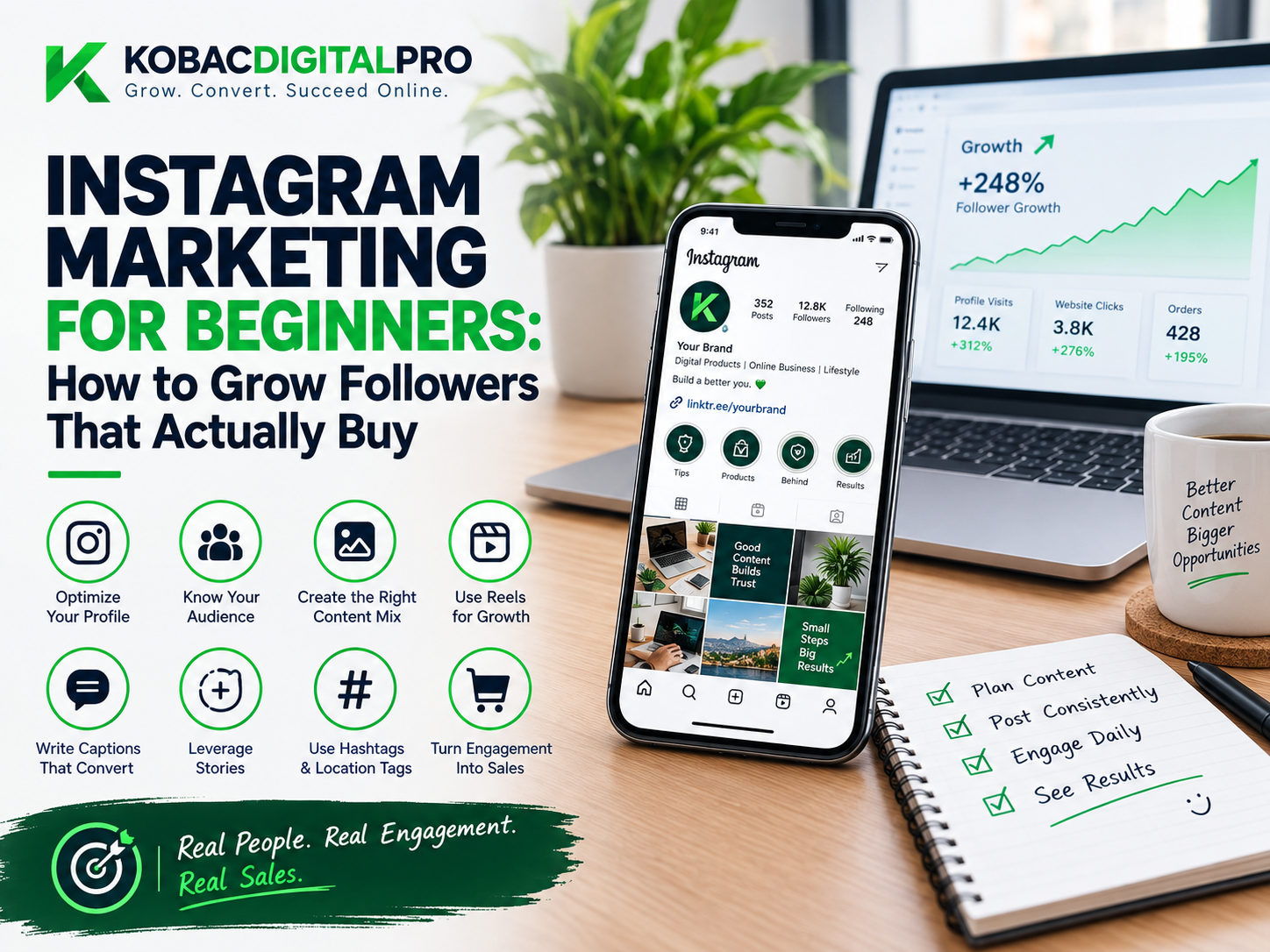
Instagram marketing for beginners usually starts with the wrong question. Most people ask “how do I get more followers?” when the question that actually matters is “how do I get the right followers — the ones who eventually buy?” A profile with 50,000 disengaged followers and zero sales is worth far less than one with 2,000 followers who trust the account enough to purchase.
This guide covers Instagram marketing for beginners from the ground up: how to set up a profile that converts, what kind of content actually attracts buyers instead of passive scrollers, and how to turn engagement into real sales rather than vanity metrics that look good but produce nothing. Every strategy below is built around a single principle: attention without trust rarely converts, but even modest attention paired with genuine trust consistently does.
Why Follower Count Is the Wrong Metric to Chase
Instagram marketing for beginners often gets derailed early by an obsession with raw follower numbers. Businesses and creators buy followers, join engagement pods, or chase viral trends unrelated to their niche, inflating a number that ultimately means very little without genuine buying interest behind it.
The metric that actually matters is the percentage of your audience that’s genuinely interested in what you sell, not the total size of your following. A smaller, targeted audience that trusts your recommendations will consistently outperform a large, disengaged one when it comes to actual revenue, which is why every strategy in this guide prioritizes attracting the right followers over simply attracting more of them. This distinction between reach and genuine influence is one beginners frequently overlook until they’ve already invested significant time chasing a number that never converts into revenue.
This last part matters more than most beginners realize, since word-of-mouth referrals from a genuinely engaged, loyal following often produce higher-quality leads than any single piece of viral content ever could.
Step 1: Set Up a Profile That Converts Before You Post Anything
Before creating content, your profile itself needs to do some selling. A visitor who lands on your profile for the first time should immediately understand who you are, what you offer, and why they should follow or buy, all within a few seconds of scanning your bio and grid. Tools like Canva make it straightforward to design a cohesive profile aesthetic and highlight covers even without prior design experience.
A strong bio includes a clear description of what you offer, a specific benefit or result you help people achieve, and a single link directing traffic to your website, shop, or a link-in-bio tool. Profile photos should be clear and recognizable at a small size, since most people encounter your profile as a tiny thumbnail before ever clicking through to see it larger.
Step 2: Understand What Your Specific Audience Actually Wants to See
Instagram marketing for beginners works best when content is built around a clearly defined audience rather than generic, broadly appealing posts. Understanding exactly who follows you — their age range, interests, pain points, and what convinces them to buy — shapes every content decision that follows.
This audience research doesn’t need to be complicated. Reviewing your existing followers, reading comments and DMs, and paying attention to which posts get saved or shared (rather than just liked) all provide direct insight into what your specific audience actually values, rather than guessing based on generic best practices.
It’s also worth revisiting this understanding periodically rather than treating it as a one-time exercise. Audiences shift as an account grows, and content that resonated with an early, smaller following doesn’t always translate perfectly once the audience expands or diversifies. Checking in on audience insights every few months keeps Instagram marketing for beginners grounded in real, current data rather than assumptions formed early on that may no longer hold true.
Step 3: Use a Content Mix That Builds Trust Before Asking for a Sale
Accounts that only post promotional content train followers to scroll past every update, since there’s no reason to engage with content that’s purely a sales pitch. A more effective content mix balances three types of posts: educational content that teaches something useful, relatable or behind-the-scenes content that builds personal connection, and promotional content that directly showcases products or services.
A common, reliable ratio is roughly 70% value-driven content (education, entertainment, relatability) and 30% direct promotion. Scheduling tools like Later make it easier to plan this mix in advance rather than deciding what to post reactively each day, which keeps followers engaged between purchases rather than only seeing your account when you’re actively trying to sell something.
Step 4: Use Reels as Your Primary Growth Tool
Instagram’s algorithm continues to prioritize Reels over static posts for reaching new, non-follower audiences, making short-form video the most effective tool for growing an account from a smaller base. Accounts that post Reels consistently tend to reach significantly more new accounts per post compared to accounts relying primarily on static image posts.
Effective Reels for Instagram marketing for beginners don’t require expensive production. A clear hook in the first one to two seconds, genuinely useful or entertaining content in the middle, and a natural call to action at the end consistently outperforms highly polished but less engaging content. Tools like CapCut make it possible to produce professional-looking Reels without expensive editing software or technical skill.
Step 5: Write Captions That Do More Than Describe the Photo
Captions are an underused opportunity in Instagram marketing for beginners. A caption that simply describes what’s already visible in the image wastes valuable space that could instead build connection, provide additional value, or move a follower toward a purchase decision.
Strong captions often open with a hook — a question, a bold statement, or a relatable observation — that stops the scroll before the photo alone would. From there, the caption can expand on the value behind the post and close with a specific call to action: visit the link in bio, comment a specific word, or share with someone who needs to see it.
Step 6: Use Instagram Stories for Daily Engagement
Stories offer a lower-pressure, more frequent way to stay visible in followers’ feeds between main grid or Reels posts. Because Stories disappear after 24 hours, they tend to feel more casual and authentic, making them ideal for behind-the-scenes content, polls, quick promotions, and direct engagement through interactive stickers.
Consistent Story use also signals to Instagram’s algorithm that an account is active, which can modestly support overall visibility across other content formats. Features like polls, question stickers, and countdown timers specifically invite engagement, which further reinforces to the algorithm that your content is worth showing to more people.
Step 7: Leverage Hashtags and Location Tags Strategically
Hashtags remain a relevant discovery tool in Instagram marketing for beginners, though their impact has shifted over the years. Rather than using the maximum allowed hashtags indiscriminately, a focused set of five to ten hashtags directly relevant to your specific niche and audience tends to outperform a broad, generic list.
Mixing hashtag sizes — some with millions of posts, others more niche with tens of thousands — balances reach potential with realistic competition for visibility. Location tags on posts, particularly for local businesses, add another discovery layer for nearby audiences actively searching that location.
Step 8: Turn Engagement Into Direct Sales With Clear Calls to Action
Followers who engage with your content but never see a clear next step rarely convert into customers on their own. Every piece of content that has commercial intent should include a specific, unambiguous call to action — “shop the link in bio,” “DM us the word STYLE for pricing,” or “swipe up to see the full collection.”
Instagram Shopping features, when available for your account and region, let followers purchase directly from tagged products in posts and Reels, removing friction from the path between seeing a product and buying it. For accounts without native shopping features enabled, a well-organized link-in-bio tool that clearly routes different types of visitors to the right destination serves a similar purpose.
Step 9: Use Influencer and Creator Partnerships to Reach New Audiences
Partnering with creators who already have an engaged, relevant audience is one of the fastest ways to reach new potential customers who trust the recommendation more than they would trust a cold ad. This doesn’t require partnering with large, expensive influencers — smaller creators with highly engaged, niche-specific audiences often produce better conversion rates per follower than broader, more expensive partnerships.
This approach to growth overlaps naturally with building income as a creator yourself. If you’re interested in the reverse side of this relationship — becoming a creator businesses want to partner with — this guide to side hustles to make money online covers how content creation and social media management can become income sources in their own right.
Step 10: Track the Metrics That Actually Predict Sales
Instagram’s built-in analytics, available through a professional or business account, show far more than just follower counts. Metrics like saves, shares, profile visits, and link clicks tend to correlate more directly with buying intent than likes or comment counts alone, since saving or sharing a post signals genuine value rather than a quick, low-effort reaction.
Meta Business Suite provides deeper analytics across both Instagram and Facebook, letting you track which specific posts drive profile visits and link clicks over time, rather than relying on surface-level engagement numbers that don’t necessarily translate into revenue.
Step 11: Use AI Tools to Speed Up Content Production
Instagram marketing for beginners has become noticeably faster to execute with AI tools handling caption drafts, content ideas, and even basic image editing, freeing up more time for the strategic decisions that actually move the needle — audience research, offer positioning, and community engagement.
If you want a broader look at how AI tools fit into building online income more generally, this guide on making money with AI covers AI-assisted content creation alongside several other practical, beginner-friendly approaches that pair naturally with a growing Instagram presence.
Step 12: Build a Community, Not Just an Audience
The most durable form of Instagram marketing for beginners treats followers as a community rather than a passive audience receiving broadcasts. Accounts that respond genuinely to comments, feature follower content, and create a sense of belonging around a shared interest or identity build a loyalty that pure content quality alone can’t replicate.
This community feel doesn’t require a huge following to start. Even a few hundred genuinely engaged followers who feel personally connected to an account tend to generate more word-of-mouth referrals and repeat purchases than a much larger audience that only encounters the account passively in their feed. Small, consistent efforts — replying to every comment in the first hour after posting, acknowledging followers by name in Stories, or running simple polls that genuinely inform future content decisions — compound into a stronger relationship over time than any single viral post could produce on its own.
How This Connects to Freelancing and Client Work
Instagram marketing skills learned for a personal brand or business translate directly into a service other businesses will pay for. Small businesses regularly need help managing their Instagram presence but don’t have the time or expertise to do it consistently themselves, creating steady demand for beginners who’ve genuinely learned how to grow an account.
If you’re considering turning these skills into freelance income, this guide on freelancing for beginners walks through exactly how to land your first client, including how to build a portfolio and pitch effectively — steps that apply directly to offering Instagram management as a specific, marketable service.
Step 13: Know When and How to Introduce Paid Promotion
Organic growth remains the foundation of Instagram marketing for beginners, but paid promotion can meaningfully accelerate results once a profile is already converting reasonably well organically. Boosting a post or running a targeted ad before your content and offer are proven to work with an organic audience usually just amplifies an unproven message to a larger, colder audience, wasting budget in the process.
A more effective sequence involves identifying which organic posts already perform well — high saves, shares, and comments relative to reach — then putting a modest budget behind those proven performers to extend their reach to a similar but larger audience. This approach uses paid spend to amplify what’s already working rather than gambling on an untested idea, which tends to produce a noticeably better return on ad spend for beginners still learning what resonates with their specific audience.
Starting with a small daily budget and testing different audiences, creative formats, and calls to action before scaling up protects against the common beginner mistake of committing a large budget to a single, unvalidated campaign. Small, deliberate tests consistently outperform large, unfocused spending for anyone still building their understanding of what works for their specific niche and audience.
Common Mistakes That Slow Down Instagram Growth
Posting inconsistently. Sporadic posting — active for two weeks, silent for a month — confuses the algorithm and followers alike. Consistency, even at a lower frequency, tends to outperform sporadic bursts of high-volume posting.
Ignoring comments and DMs. Instagram’s algorithm favors accounts with genuine two-way engagement. Failing to respond to comments and messages signals a passive, one-directional account, which both hurts algorithmic reach and misses direct sales conversations.
Copying competitors without adapting to your own audience. What works for a larger, more established competitor doesn’t automatically transfer to a smaller, newer account with a different audience and level of trust. Testing and adapting based on your own data matters more than mimicking others.
Neglecting Stories in favor of only grid content. Stories offer some of the highest-frequency engagement opportunities available, and accounts that skip them miss a significant amount of potential daily visibility. Since Stories appear at the very top of followers’ feeds, consistently skipping this format means losing one of the easiest, lowest-effort ways to stay visible between larger content pushes.
Focusing entirely on aesthetics over substance. A beautifully curated grid with no genuine value or personality behind it rarely converts as well as a slightly less polished account that consistently provides real value and builds authentic connection with its audience.
Frequently Asked Questions
How long does it take to see real results from Instagram marketing for beginners?
Meaningful growth and engagement typically take three to six months of consistent posting and audience-building, though initial traction from Reels can sometimes appear faster if content resonates immediately with the right audience segment.
Do I need a large following before I can start selling on Instagram?
No. Accounts with a few thousand highly engaged, relevant followers regularly outperform much larger accounts with disengaged audiences when it comes to actual sales and conversions.
How often should beginners post on Instagram?
Three to five feed posts per week combined with daily Stories tends to produce solid results for beginners, though consistency matters more than hitting an exact number.
Is it worth paying for Instagram ads as a beginner?
Paid promotion can accelerate growth once organic content is already converting reasonably well, but spending on ads before your profile and content are optimized to convert typically wastes budget on traffic that won’t buy.
What’s the biggest mistake beginners make with Instagram marketing?
Prioritizing follower count over genuine audience engagement and trust. A large but disengaged following looks impressive but rarely translates into meaningful sales or business growth.
Should I focus on one content format or try everything at once?
Beginners generally see faster, more consistent results focusing primarily on Reels for growth and Stories for daily engagement, rather than spreading thin effort evenly across every available format from the start.
How important is it to niche down for Instagram marketing for beginners?
Very important. A specific, well-defined niche makes content creation easier, attracts a more relevant audience, and produces higher conversion rates than trying to appeal broadly to everyone.
Can Instagram marketing for beginners work without showing your face?
Yes. Product-focused accounts, text-based educational content, and voiceover-style Reels can all grow successfully without the creator appearing on camera, though building personal connection may take a somewhat different approach than face-forward content.
Final Thoughts
Instagram marketing for beginners succeeds when the focus shifts from chasing follower counts to building genuine trust with a specific, well-understood audience. A converting profile, a thoughtful content mix, consistent Reels and Stories, and clear calls to action all work together to turn casual scrollers into engaged followers, and engaged followers into actual customers.
The accounts that grow sustainably aren’t the ones chasing every trend or buying followers to inflate a number. They’re the ones that consistently show up, genuinely understand their audience, and make it easy for that audience to take the next step when they’re ready to buy. Mastering Instagram marketing for beginners isn’t about learning every feature the platform offers — it’s about applying a small set of proven principles consistently, long enough for trust and momentum to build.