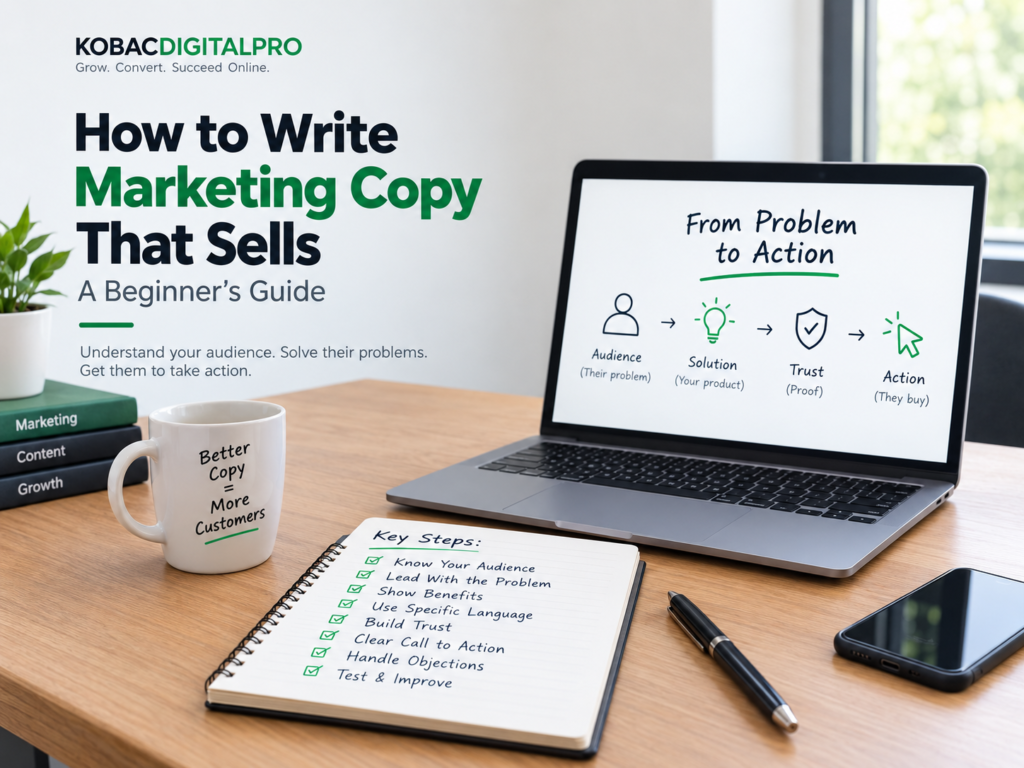
How to write marketing copy that sells is one of the most valuable skills any business owner or marketer can learn, and it’s also one of the most misunderstood. Most beginners assume good copy means clever wordplay or big, exciting claims. In reality, the copy that actually sells is almost always simple, specific, and built entirely around the reader’s problem — not the product itself.
This guide breaks down exactly how to write marketing copy that sells, using principles that work whether you’re writing a landing page, an email, a social media caption, or a product description. No jargon, no theory for theory’s sake — just the practical building blocks that separate copy people ignore from copy that gets clicked, read, and acted on.
Whether you’re a complete beginner writing your first product description or someone who’s been in marketing for years but never formally studied copywriting, the fundamentals in this guide apply the same way, because how to write marketing copy that sells doesn’t change based on experience level — it changes based on how well you understand the person reading it.
What Marketing Copy Actually Has to Do
Before learning how to write marketing copy that sells, it helps to be clear about what copy is actually for. Its only job is to move someone from where they currently are — unaware, skeptical, or undecided — to a specific next action, whether that’s clicking a button, entering their email, or making a purchase.
Copy that fails to sell almost always fails at this transition. It might be well-written in a technical sense, grammatically clean, even entertaining, but if it doesn’t clearly connect the reader’s problem to the product’s solution and then ask for the next step, it won’t convert. Understanding this single job is the foundation everything else in this guide on how to write marketing copy that sells builds on.
Why Most Marketing Copy Fails
The vast majority of underperforming marketing copy shares the same root problem: it’s written from the business’s perspective instead of the customer’s. Phrases like “we are proud to offer” or “our innovative solution” describe how the business feels about itself, not what the customer gets or why they should care.
Learning how to write marketing copy that sells starts with a mental shift — every sentence should answer the reader’s unspoken question, “what does this mean for me?” Resources like Copyblogger have built entire content libraries around this exact principle, consistently emphasizing customer-focused language over company-focused messaging. If a line doesn’t pass that test, it’s usually either cut or rewritten from the customer’s point of view.
Step 1: Know Exactly Who You’re Writing To
Copy written for “everyone” convinces no one. This is the starting point for how to write marketing copy that sells consistently: before writing a single sentence, get specific about who you’re talking to — their exact problem, what they’ve already tried, what’s stopped them from solving it, and what language they naturally use to describe their frustration.
This last part matters more than most beginners realize. Copy that mirrors the customer’s own words — pulled from reviews, support tickets, or direct conversations — consistently outperforms copy built purely from internal brainstorming, because it sounds like something the reader would say themselves rather than something a company invented.
Step 2: Lead With the Problem, Not the Product
One of the clearest patterns in how to write marketing copy that sells is leading with the reader’s problem before introducing the solution. Readers skim past product descriptions that open with company history or feature lists, but they slow down the moment they see their own frustration described accurately.
A simple structure that works reliably: name the specific problem, briefly agree with how frustrating or costly it is, then introduce the product as the natural resolution. This order matters — introducing the product too early, before the reader feels understood, weakens everything that follows.
Step 3: Sell Benefits, Not Just Features
A core part of how to write marketing copy that sells is knowing the difference between a feature and a benefit. A feature is what a product does. A benefit is what that feature actually means for the person using it. “24/7 customer support” is a feature. “Never wait until Monday to fix a problem that’s costing you money right now” is the benefit behind it, and it’s the benefit that actually moves someone toward a decision.
Every feature worth mentioning in marketing copy should be followed, explicitly or implicitly, by an answer to “so what does that mean for me?” HubSpot’s research on copywriting consistently shows that benefit-driven headlines outperform feature-driven ones across nearly every industry tested. If a feature can’t be translated into a clear, tangible benefit, it usually doesn’t belong in the copy at all.
Step 4: Use Specific, Concrete Language
Vague claims like “save time” or “boost your results” are easy to write and easy to ignore, because they could describe almost anything. Specific claims — “save four hours a week on manual data entry” or “increase email open rates by 22%” — feel real, believable, and worth paying attention to. Anyone learning how to write marketing copy that sells should treat this as one of the first habits to build.
This is one of the most reliable tactics in how to write marketing copy that sells: replace every vague adjective with a specific number, timeframe, or concrete outcome wherever the claim can be honestly supported. Specificity signals confidence and gives the reader something tangible to picture, which vague language never accomplishes.
Step 5: Build Trust With Proof
Understanding how to write marketing copy that sells means accepting that even well-written, benefit-focused copy struggles to convert without some form of proof that the claims are true. Testimonials, case studies, specific statistics, and third-party endorsements all do the work of reducing the skepticism every reader brings to marketing content by default.
The strongest proof is specific rather than generic. A testimonial that says “This service is great” does far less work than one that says “This cut our onboarding time from three weeks to four days.” Whenever possible, seek out or highlight the specific, measurable version of positive feedback rather than the vague, enthusiastic version.
Step 6: Write a Clear, Single Call to Action
Confused readers don’t buy. Every piece of marketing copy should point toward exactly one next step, stated clearly and without ambiguity: “Start your free trial,” “Book a call,” “Add to cart.” Multiple competing calls to action in the same piece of copy — asking readers to also follow on social media, also read another article, also sign up for something else — dilutes the one action that actually matters most.
This is a subtle but important part of how to write marketing copy that sells consistently: decide on the single most important action before writing, then make sure every other element in the copy supports that one goal rather than competing with it.
Step 7: Address Objections Before They’re Raised
A frequently overlooked piece of how to write marketing copy that sells is objection handling. Every potential customer has silent objections running through their mind while reading — it’s too expensive, it won’t work for my specific situation, I’ve been burned by something similar before. Copy that ignores these objections leaves them unresolved, and unresolved objections are exactly what stops someone from taking action.
Strong marketing copy names the most common objections directly and answers them within the copy itself, often through a dedicated FAQ section, a guarantee, or a specific line addressing the concern head-on. Anticipating objections rather than hoping the reader won’t think of them is a distinguishing habit of copy that actually sells.
Step 8: Match Copy Length to Purchase Complexity
A common beginner mistake in how to write marketing copy that sells is assuming shorter copy always converts better, or the opposite assumption that longer copy is always more persuasive. Neither is universally true. The right length depends on how much the reader already knows and how big the decision feels to them.
A $15 impulse purchase needs very little convincing — short, punchy copy focused on a single compelling benefit usually outperforms a long explanation. A $3,000 B2B software decision, on the other hand, often requires substantially more proof, detail, and objection-handling before a reader feels comfortable moving forward. Matching length to the actual weight of the decision is a core, often overlooked part of how to write marketing copy that sells across different price points.
Step 9: Edit Ruthlessly for Clarity
A large part of how to write marketing copy that sells actually happens during editing, not drafting. The first draft of almost any piece of marketing copy is too long, too vague, and too focused on the business rather than the customer. Editing is where copy actually becomes persuasive — cutting unnecessary words, replacing jargon with plain language, and removing any sentence that doesn’t directly support the single goal of the piece.
A useful editing test: read the copy aloud. Sentences that feel clunky, overly formal, or hard to say naturally almost always read the same way to a customer skimming quickly, and they’re usually the first candidates for cutting or simplifying.
Step 10: Test and Refine Based on Real Data
Even experienced copywriters can’t reliably predict which version of a headline, call to action, or opening line will perform best without testing. A/B testing different versions of key copy elements — headlines, button text, subject lines — replaces guesswork with actual reader behavior, which is ultimately the only reliable teacher for how to write marketing copy that sells for your specific audience.
Tools like Google Optimize alternatives and built-in A/B testing features in most email platforms make this accessible even for beginners without a dedicated analytics team. Reviewing performance data regularly and adjusting copy based on what readers actually do — not just what sounds persuasive internally — is what separates copywriters who improve over time from those who repeat the same underperforming patterns indefinitely.
Step 11: Write Headlines That Earn the Rest of the Read
Every principle in how to write marketing copy that sells means nothing if the headline fails to earn attention in the first place. On average, far more people read a headline than read the body copy that follows it, which makes the headline arguably the single highest-leverage sentence in any piece of marketing copy.
Strong headlines typically do one of a few things: state a specific, desirable outcome, ask a question the reader is already asking themselves, or name the exact problem the reader is currently experiencing. Vague, clever headlines that prioritize wordplay over clarity routinely underperform straightforward headlines that simply tell the reader what they’ll get, because confused readers rarely stick around long enough to appreciate cleverness.
A practical exercise worth doing before finalizing any piece of copy: write ten different headline options, then pick the one that most specifically and clearly communicates the core benefit, rather than defaulting to the first idea that came to mind. This habit alone tends to separate copy that gets read from copy that gets scrolled past.
How the Principles Change (and Stay the Same) Across Formats
Understanding how to write marketing copy that sells across different formats matters because the core principles stay constant while the execution shifts significantly. Email copy, landing pages, social captions, and ad copy all demand the same customer-first thinking, but the pacing and structure look different in each.
Email copy tends to work best when it reads like a message from one person to another rather than a formal announcement, with a single clear call to action reinforced once, maybe twice, without overwhelming the reader with multiple competing links. Landing page copy typically needs more proof and objection handling than email, since a visitor arriving from an ad or search result usually knows less about the offer and needs more convincing before committing. Social media captions operate under much tighter attention constraints, which means the problem-benefit-action structure has to compress into two or three lines rather than several paragraphs, often relying on the first line alone to stop the scroll.
Despite these differences, how to write marketing copy that sells never really changes: identify the specific reader, name their problem clearly, present the benefit in concrete terms, and ask for one clear next step. The format changes the packaging, not the underlying formula.
Common Mistakes That Weaken Marketing Copy
Writing about the company instead of the customer. Copy filled with “we,” “our,” and company achievements rarely converts as well as copy filled with “you” and the customer’s specific outcome.
Overusing superlatives without proof. Claims like “the best,” “revolutionary,” or “game-changing” mean nothing without specific evidence behind them, and overuse trains readers to skim past and distrust similar claims elsewhere in the copy.
Burying the call to action. If a reader has to search for what they’re supposed to do next, most won’t bother looking. The next step should always be obvious and easy to find.
Ignoring mobile readability. A large percentage of marketing copy is read on a phone screen. Research from the Nielsen Norman Group has repeatedly found that mobile readers skim rather than read line by line, which means long, dense paragraphs that look fine on a desktop often become an unreadable wall of text on mobile, directly hurting conversion.
Skipping objection handling entirely. Copy that only presents the positive case, without acknowledging obvious hesitations, leaves the reader to resolve those doubts alone — and most simply leave instead.
How This Connects to Your Broader Marketing Strategy
Copywriting doesn’t exist in isolation. The same principles behind how to write marketing copy that sells apply directly to the content you create across every channel — website pages, ads, social captions, and emails all rely on the same core skill of connecting a reader’s problem to a clear next step.
If you’re building out a broader content strategy, some of the tactics in these marketing tips that actually work pair naturally with strong copywriting, particularly around repurposing content and using short-form video to reach audiences before they ever read a full page of copy.
Copywriting skills are also increasingly valuable as a standalone income source. If you’re interested in turning strong copywriting ability into a business, this breakdown of side hustles to make money online covers freelance writing and related paths in more detail, including realistic income expectations for beginners.
AI tools have also changed how copy gets drafted, though the fundamentals covered in this guide matter more than ever specifically because AI can produce a first draft quickly but still needs human judgment to make it genuinely persuasive. For a broader look at how AI fits into online income more generally, this guide on making money with AI covers AI-assisted writing alongside nine other practical approaches.
Frequently Asked Questions
What’s the single most important skill in how to write marketing copy that sells?
Understanding your specific reader’s problem better than they can articulate it themselves. Every other technique — benefits over features, objection handling, clear calls to action — depends on first getting this right.
Do I need to be naturally talented at writing to learn how to write marketing copy that sells?
No. Persuasive copywriting is a learnable skill built on structure and customer understanding rather than natural writing talent. Many highly effective copywriters describe themselves as average writers who are excellent at understanding what customers actually want to hear.
How long should marketing copy be?
It depends entirely on the complexity of the decision being asked of the reader. Simple, low-cost, low-risk purchases need less convincing than complex, expensive, or unfamiliar ones — match the length to the weight of the decision, not to a fixed rule.
Can AI write marketing copy that sells on its own?
AI tools can produce a strong first draft quickly, but copy that genuinely sells still requires human judgment — understanding the specific audience, adding real proof, and editing ruthlessly for clarity — steps that AI alone consistently misses without human oversight.
What’s the fastest way to improve at writing marketing copy that sells?
Study copy that’s already working in your industry, pay close attention to the actual words your customers use to describe their problems, and test different versions of your own copy against real reader behavior rather than internal opinions.
Final Thoughts
How to write marketing copy that sells ultimately comes down to a simple discipline: understanding your reader’s problem more clearly than they can state it themselves, then guiding them toward one specific action without unnecessary friction or ambiguity. Every technique in this guide — leading with the problem, translating features into benefits, using specific language, and handling objections directly — serves that same underlying goal.
Copy that sells isn’t the copy that sounds the most impressive to write. It’s the copy that makes the reader feel understood, then makes the next step so obvious they barely have to think about taking it. Master that discipline, and the specific words become far easier to find.