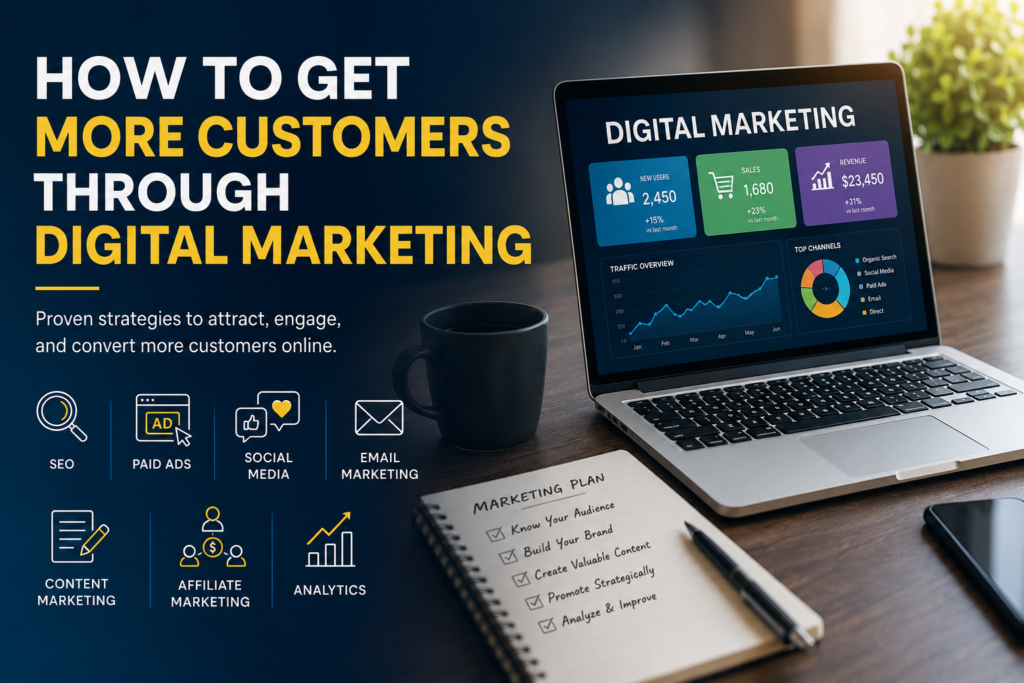
Get more customers through digital marketing by focusing on where your customers already are, giving them a reason to trust your business, and making it easy for them to take the next step.
The challenge is that many businesses use too many marketing tactics without a clear strategy. They post on social media, publish blog posts, run ads, and send emails—but never know which activities are actually generating customers.
This guide explains practical ways to use digital marketing to attract more customers, build trust, and turn online visitors into real leads and sales.
Why Digital Marketing Matters for Customer Growth
Digital marketing allows businesses to reach potential customers based on factors such as search intent, interests, location, behavior, and previous interactions with a brand.
Instead of relying only on broad advertising, businesses can create targeted campaigns designed around specific customer needs.
For example, someone searching for “web design company near me” is already showing interest in a service. A well-optimized website can put your business in front of that person at the right moment.
The key is not simply getting more traffic. The goal is getting the right traffic and converting it into customers.
Step 1: Know Your Target Customer
Before investing money or time into digital marketing, define exactly who you want to reach.
Start by answering these questions:
- What problem does your product or service solve?
- Who is most likely to need it?
- Where does your target customer live?
- What websites and social platforms do they use?
- What factors influence their buying decision?
- What concerns might stop them from purchasing?
The more clearly you understand your audience, the easier it becomes to create relevant content, advertisements, offers, and landing pages.
Avoid trying to market to everyone. A specific audience usually gives you a much clearer marketing strategy.
Step 2: Create a Website That Converts Visitors
Your website is often the center of your digital marketing strategy.
You can generate thousands of visitors, but if your website is confusing or difficult to use, much of that traffic will never become a customer.
A customer-focused website should include:
- A clear headline explaining what you offer
- Simple navigation so visitors can quickly find what they need
- Fast loading speeds across desktop and mobile devices
- Strong calls to action such as “Get a Quote,” “Contact Us,” or “Buy Now”
- Mobile-friendly design for smartphone users
- Customer reviews and testimonials to build credibility
- Clear contact information that is easy to find
Before spending heavily on advertising, make sure your website is capable of converting the traffic you are paying to attract.
Step 3: Use SEO to Reach People Searching for Your Services
Search engine optimization (SEO) helps your website appear when potential customers search for information, products, or services related to your business.
For example, an accountant could target searches such as:
- “accountant near me”
- “small business accountant”
- “tax services for small businesses”
Instead of trying to rank for every possible keyword, focus on search terms that are relevant to your business and realistic for your website to compete for.
An effective SEO strategy should include:
- Researching relevant keywords
- Creating useful, original content
- Optimizing page titles and headings
- Writing helpful meta descriptions
- Improving website speed and usability
- Building relevant and trustworthy backlinks
- Keeping important content updated
SEO usually takes longer than paid advertising, especially in competitive industries. However, successful organic rankings can continue attracting visitors without paying for every individual click.
If you’re deciding between SEO and social media, see our guide on SEO vs Social Media Marketing for a closer comparison.
Step 4: Use Paid Advertising for Faster Visibility
When a business needs traffic and leads quickly, paid advertising can be one of the most direct options.
Platforms such as Google Ads and Meta Ads allow businesses to target audiences based on factors including search intent, location, interests, demographics, and previous interactions.
But running ads does not automatically mean getting profitable customers.
To improve your campaigns:
- Start with a controlled budget
- Test different headlines and offers
- Use dedicated landing pages
- Track leads and sales
- Monitor your cost per acquisition
- Retarget visitors who did not convert
- Increase spending only when the numbers justify it
The important metric is not simply how many clicks you receive. You need to know how many of those clicks become leads or paying customers.
Step 5: Build an Email Marketing List
Social media platforms can help businesses reach large audiences, but you do not control their algorithms.
Email gives you a direct communication channel with people who have chosen to hear from your business.
You can grow an email list by offering something useful in exchange for a signup, such as:
- A discount
- A free guide
- A checklist
- A useful template
- Exclusive information
Once someone joins your list, avoid sending nothing but promotional messages.
A simple email strategy can include:
- A welcome email
- Helpful educational content
- Product or service recommendations
- Customer stories or case studies
- Occasional special offers
The objective is to stay useful and relevant so that your business remains familiar when the customer is ready to buy.
Step 6: Use Social Media to Build Trust
Social media is not always the fastest path to a direct sale, but it can be extremely useful for building awareness and credibility.
Potential customers can use your social profiles to understand what your business does, see your work, read customer feedback, and communicate with you.
Focus on content that demonstrates expertise and builds trust.
Examples include:
- Educational short videos
- Customer success stories
- Behind-the-scenes content
- Product demonstrations
- Frequently asked questions
- Industry tips
- Before-and-after examples
Consistency matters more than publishing a large amount of content for a short period and then disappearing.
For more practical ideas, see our guide to Social Media Marketing Tips That Actually Work in 2026.
Step 7: Create Content That Solves Customer Problems
Content marketing works best when it focuses on the problems your potential customers actually have.
Instead of constantly writing about your own products, answer questions that people are already asking.
For example, a plumbing company could publish:
“How to Tell If Your Home Has a Hidden Water Leak”
A digital marketing agency could publish:
“How Much Should a Small Business Spend on Digital Marketing?”
This type of content can attract people before they are ready to buy and introduce them to your business while they are researching a problem.
Useful content can also support your SEO strategy by creating more opportunities for your website to appear in search results.
Step 8: Use Partnerships and Affiliate Marketing
Partnerships can help businesses reach audiences they would struggle to reach on their own.
Affiliate marketing is one example. Instead of paying a partner simply to promote your product, you can structure a commission based on qualified sales or other agreed actions.
Affiliate marketing can work particularly well for:
- Software products
- Online courses
- Digital products
- Subscription services
- E-commerce products
However, it is not suitable for every business. You need enough profit margin to support commissions, and your partners need an audience that is genuinely relevant to your offer.
If affiliate marketing fits your business model, our guide to Affiliate Marketing Strategies explains how to approach it more strategically.
Step 9: Measure What Is Actually Producing Customers
Digital marketing becomes much more effective when you measure the results.
Tools such as Google Analytics can help you understand where website visitors come from and what they do after arriving on your site.
Depending on your business, you should track metrics such as:
- Website traffic
- Organic search traffic
- Leads generated
- Conversion rate
- Cost per lead
- Cost per customer
- Sales generated
- Email engagement
- Paid advertising performance
Do not focus only on traffic numbers.
Getting 10,000 visitors is not necessarily better than getting 1,000 visitors if those 1,000 visitors are much more likely to become customers.
If your website also uses display advertising, Google AdSense can provide additional revenue data. However, advertising revenue and customer acquisition should be measured separately because they represent different business goals.
Step 10: Combine Your Marketing Channels
The strongest digital marketing strategies usually connect multiple channels instead of treating each channel as a separate project.
For example, one detailed blog post can become:
- An SEO landing page
- Several social media posts
- A short-form video
- An email newsletter
- A source for paid advertising
- A downloadable guide
This approach allows you to get more value from the content you already create.
SEO can bring search traffic. Social media can increase awareness. Paid advertising can provide faster visibility. Email can bring previous visitors back. Partnerships can introduce your business to new audiences.
The channels work best when they support the same overall goal.
A structured digital marketing plan can help you organize these activities around your budget, audience, and business objectives.
Common Digital Marketing Mistakes
Trying Every Channel at Once
A small business does not need to be active on every platform.
Trying to manage SEO, multiple social networks, paid advertising, email, video, affiliate marketing, and several other channels at the same time can spread your resources too thin.
Start with the channels most likely to reach your target customer.
Sending Traffic to a Weak Website
More traffic will not solve a conversion problem.
If visitors cannot quickly understand your offer or find a way to contact you, increasing traffic may simply increase wasted spending.
Expecting SEO to Work Immediately
SEO is a long-term strategy. Competitive keywords can take significant time to rank for, and results vary depending on the website, competition, content quality, authority, and technical performance.
Focusing Only on New Customers
Existing customers can be valuable for repeat purchases, referrals, and long-term revenue.
Email campaigns, customer follow-ups, loyalty programs, and remarketing can help you generate more value from people who already know your business.
Measuring the Wrong Numbers
Followers, impressions, and website visits can be useful indicators, but they do not automatically equal revenue.
Always connect marketing activity to business outcomes whenever possible.
Frequently Asked Questions
What is the fastest way to get more customers through digital marketing?
Paid advertising can generate visibility and potential leads quickly, provided the offer, targeting, landing page, and conversion process are strong. SEO and content marketing generally take longer to develop but can create sustainable organic traffic.
Do I need a large budget?
No. A business can start with a small budget by focusing on a strong website, local or niche SEO, useful content, and consistent customer communication.
The important thing is to avoid spending money across too many channels without measuring the results.
Which digital marketing channel is the best?
There is no single best channel for every business.
A local service business may benefit heavily from local SEO and Google Ads. An e-commerce brand may rely more on paid social, SEO, email, and content. A software company may benefit from SEO, educational content, email, partnerships, and paid search.
The right channel depends on where your customers are and how they make buying decisions.
How long does digital marketing take to produce results?
The timeline varies by channel.
Paid advertising can produce traffic and leads quickly, while SEO and content marketing generally require more time to build momentum. Email marketing can produce results relatively quickly when a business already has a relevant audience.
Instead of expecting a fixed timeline, measure progress using meaningful metrics such as qualified leads, conversions, customer acquisition cost, and revenue.
Final Thoughts
Getting more customers through digital marketing is not about using every available platform. It is about building a system that connects the right audience with the right message at the right time.
Start by understanding your customers and building a website that converts. Then use SEO and useful content to capture organic demand, paid advertising when faster visibility makes sense, social media to build trust, and email to maintain relationships.
Most importantly, measure the results.
The businesses that grow consistently online are not necessarily the ones with the biggest marketing budgets. They are the ones that understand their customers, focus on the channels that matter, test their strategies, and invest more in the activities that actually produce business results.
That is the real foundation of getting more customers through digital marketing.